ABBA blog
Thoughts and observations on the Swedish foursome
Five essays in ABBA – The Complete Recording Sessions
published August 26, 2026
Some of my own favourite sections in ABBA – The Complete Recording Sessions 1972–1982 are the five essays, allowing the reader to trace the development of a typical ABBA song from the writing up until the mixing. Judging by the feedback, they've been appreciated by readers as well.
Those extensive essays were by far the most complicated pieces of writing in the book. I remember when I was going to put together the first of them, Writing the tunes, and thinking to myself, "Oh, this will take no more than two or three days". Two weeks later the darned thing was finally completed. That's pretty much how it turned out with all the essays. The reason it took so much longer than I had anticipated was that I wanted the essays to be highly informative, yet readable, and that took a lot of time to accomplish.
Here are excerpts from all five essays for your reading pleasure.
WRITING THE TUNES
When Björn and Benny met in 1966, they had only recently established themselves individually as credible songwriters; perhaps Benny in particular, who’d enjoyed a string of big, self-written hits with the Hep Stars. Nevertheless, although they were both perfectly capable of writing songs alone, by 1969 they had decided to work as a team for the foreseeable future. By this time they had truly realised the benefits of working together. “Björn hears what I don’t hear in my music, if a good thing emerges,” explained Benny in a 1982 interview. “And I can hear [in Björn’s melody lines] what he himself doesn’t hear.”
“It’s a natural state to be two,” elaborated Björn in 1993, looking back on his and Benny’s collaboration during ABBA’s heyday. “One stands for one thing and the other stands for something else; you provide a balance for each other. When one gets too sugary, the other is aware that, ‘no, no, we can’t have that’, and, perhaps, also the other way around. In some way you fill in the blank spaces for each other, and at the same time you have a sounding board. It’s just easier, quite simply, to be two; more practical somehow. Of course, you could work on your own, but firstly, it isn’t as much fun, and secondly, it’s much easier to get stuck.”
WRITING THE LYRICS
It was around the time of ‘Fernando’ that Björn became increasingly concerned that the production values of ABBA’s music weren’t always matched by the lyrics. This development ran parallel with the changing nature of his and Benny’s partnership; the latter was an ever more dominant driving force when the melodies were written and so it was natural for Björn to concentrate more on the lyrics. In interviews he began acknowledging that the lyrics could be better, not necessarily meaning that they had to become socially conscious – “I always thought it was so boring with the political music movement we had here in Sweden in the 1970s, when everybody was so totally realistic and almost party-political,” he says today – but with more interesting imagery and a degree of personal depth.
“It is possible that we’ve been concentrating too much on the music and neglecting the lyrics,” he mused at the time when ABBA had just started recording the Arrival album, and the following year he admitted that “the content has suffered” as a result of their almost total focus on the sound of the words rather than their meaning. He concluded that if there was no way escaping the task of writing lyrics, no matter if he enjoyed it or not, he might as well grab the bull by the horns and regard it as an interesting challenge rather than as a chore. While it was true that ABBA had never pretended to be anything other than a pop band, Björn felt some of the songs would be more powerful if the lyrics were a notch or two above the earlier, sometimes impersonal fare. This lyricist was determined not to write any more ‘King Kong Songs’.
RECORDING THE BACKING TRACKS
After perhaps one or two run-throughs of the song, the musicians would sit down at their instruments, put on their headphones and start playing. The guitarist, the bass player and Benny would all be in the same room, while the drummer was in his booth, which had windows so that the others could have eye-contact with him. The musicians would discuss among themselves, listen to what Benny and Björn had to say, and make notes on their chord sheets. “We would try to work ourselves into some kind of groove or some sort of understanding,” explains Benny.
The Andersson/Ulvaeus team would have a general feeling of what type of song they had written, and so the process of working out an arrangement in the studio usually started off in a particular style. But Benny and Björn still kept an open mind as the musicians acquainted themselves with the tune. Says Benny, “Although we would always have some kind of idea of how the song should sound, we would seldom tell the musicians, ‘We want it to sound like this.’ The thing is that out of ten songs that you like before you go into the studio, you have to be satisfied if five end up as good as you thought they would, four end up worse, and one of them ends up even better than you thought. So when you knew that there was the possibility to improve on a song in the studio, with a certain kind of tempo or a guitar riff or whatever, you would only tell the musicians, ‘This is where the song starts now, but we will decide later which parts we will return to, and where the song will end’. That’s the whole point of having good musicians in the studio, to give them room and let them contribute to the arrangement.”
Having heard Björn and Benny’s rendition of the tune a couple of times, the musicians were ready to start coming up with parts. It was all about finding a format for the song; this would have been difficult for Björn and Benny to figure out on their own – with the musicians present they could hear in real time how things would work out. “We’d just play around for a bit and then something came up that someone reacted to, some fragment that maybe was turned into an intro later on,” said guitarist Lasse Wellander. “Things would emerge that you could grab hold of: a bass riff, or the start of a guitar line – it could be anything, really.” While this was happening, the musicians had a very attentive listener in Björn. “I would usually be sitting there with my headphones on and listen, saying, ‘That bit, Lasse, that’s damn good; that’s great, that will work.’ You’d do a sort of jig-saw puzzle and if you were lucky the pieces would all end up in the right places.”
RECORDING THE VOCALS
“Every melody line in an arrangement needs to have somewhere to start and somewhere to go, in a natural way preferably,” explained Benny. “The same thing applies in an orchestra. If you are writing a bassoon part, you should ideally create a line that means something to the person playing that line, not just a series of notes that fit with the melody – and that’s what we tried to do with the backing vocals, looking for natural counterpoints and melodies.”
As these choir parts were worked out, the female half of ABBA were able to add ideas and suggestions and be truly creative, something they both thoroughly enjoyed. Gathered around the piano, those ideas would emerge instinctively. “Once I’ve learned the melody,” said Agnetha at the time, “I can often ‘hear’ something at the back of that: if there should be a choir, what the choir should ‘answer’, or if it should interject something.”
“Creativity is something that works really well when you’re in a studio environment,” agrees Frida. “We’d sing along to the piano or sometimes to the tape with the backing track. When you kept hearing the melody over and over, and you’d be working on it, other things would emerge, like little choir bits or a ‘response’. You’d say, ‘This bit here I think sounds good, it feels good’. Then you’d try it out, and if it worked we kept it. So there was a lot of improvisation going on when we were working out the choir parts.”
Although Björn and Benny already had clear ideas of the general direction – through working for so long at the song before Agnetha and Frida entered the process – they did welcome their suggestions, “trying to be open and flexible so that you hear when they offer something better,” as Björn once put it. Indeed, there is plenty of evidence on session tapes of Agnetha and Frida coming up with ideas and solutions to vocal conundrums. As Michael Tretow has remarked, whether it was a matter of harmony parts or a shared lead vocal, this was the part of the vocal recording session that took time. “The main work was, ‘If we should put a little emphasis on the end of that word, then we will both have to do it at the exact same tempo’. Or ,‘What if we try with you starting to sing at this point and then you add your thing in that bit’. Learning the songs went incredibly quickly – the actual job was the fine-tuning of the vocal arrangement.”
During the process of working out the harmony and choir parts, the women would also start getting a feel for the lyrics: whether they felt right and were comfortable to sing, just as words in combination with the melody. “The lyrics have to fit the music in a way,” said Frida at the time. “Then [Agnetha and I] will have the final word. If you can’t sing a song so that you feel good about it, naturally the lyrics have to be changed.” Sometimes it could be a case of certain vowel sounds that were uncomfortable to sing, and perhaps didn’t sound very nice either, when they were reaching for the highest notes.
OVERDUBBING AND MIXING
“Here is the song, here are the tunes, here are the harmonies and here is the basic backing track. And there you are. We’ve sung it. It’s locked and finished. It’s as good as we could do it so far. Is there anything more to do? Is it possible to come up with some sounds or something? That’s what I’m working on at that stage.” In a 1980 interview, this was how Benny Andersson described the final part in the creation of ABBA’s songs: the overdubbing and the mixing.
Although the mixing is ostensibly the very last stage of the process of recording, in ABBA’s case there was usually an overlap. For after having already filled the tape with so many musical elements, during the mixing Björn and Benny would often feel that the recording would become even better if they added further chords, riffs, counterpoint melodies – any addition or decoration that would enhance the song. Benny once described his function on the ABBA records as “some kind of ‘orchestra’, filling up the sound in the background”: considering the many overdubs he did to ABBA’s recordings, this description certainly makes sense.
Strictly speaking, the overdubbing began as soon as the basic backing track tape of drums, bass, guitar and keyboard had been recorded. That is, to those four elements would be added further sounds, perhaps mainly in the shape of Benny’s keyboards but sometimes also acoustic guitars, giving the recording a bit more atmosphere: this was the kind of tape Björn liked to work from when he wrote the lyrics for the song. “He wanted as many overdubs as possible,” says Benny, “something that was close to what the end result might be; sometimes we’d even add strings at this stage.” In a 1980 article, Michael Tretow noted somewhat wryly how ambitious even those first overdub sessions would be. “Björn and Benny are trying to fill up the tracks as fast as the machine will go. That means that there are two empty tracks left at lunchtime, and it’s time to reduce the 16 Moog tracks to make room for the vocal track that the record-buyers so urgently demand.” Those Moog tracks would be reduced by mixing them together on fewer tracks, thus freeing up more tracks on the 24-track tape; indeed, as the recording evolved, many of the initial overdubs could very well be replaced by something else entirely.
The lyrics written, and after Agnetha and Frida had spent a day in the studio adding their vocals, the real overdubbing process would start. “The recordings, the arrangements, the solos, all the overdubs you do, are awfully important to give the songs the character you want them to have,” explained Benny in 1976. “A record isn’t just a melody, a voice and a backing, but more of a complete picture.” By this he meant that it was no longer enough to put musicians and singers together in a studio, press the record button and capture the performance in the moment, as had been the basic recording method not too long ago. It was all about making a construction, adding elements piece by piece, so that the arrangement and the production became an integral part of the song itself. With as many as 24 tracks available by the mid-1970s, this was now possible.
---------
Is your appetite whetted to read the complete essays, and all the other facts and stories about ABBA's musical creativity? Then please order your own copy of ABBA – The Complete Recording Sessions 1972–1982.
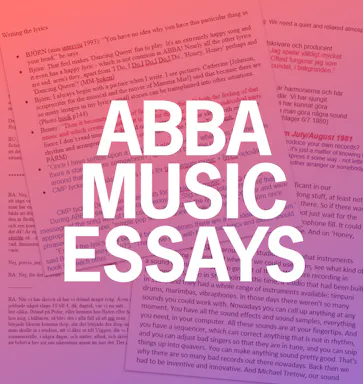
Some of the pages and pages of research material that formed the basis of the five "how the music was made" essays in ABBA – The Complete Recording Sessions 1972–1982.
ABBA
BooksStudio albumsCompilations and box setsDVDsSolo projectsGuided tour of ABBA's StockholmABBA lectureMore ABBA© 2003–2025 Carl Magnus Palm. All rights reserved. Produced by Disco Works